An executive briefing on enterprise AI

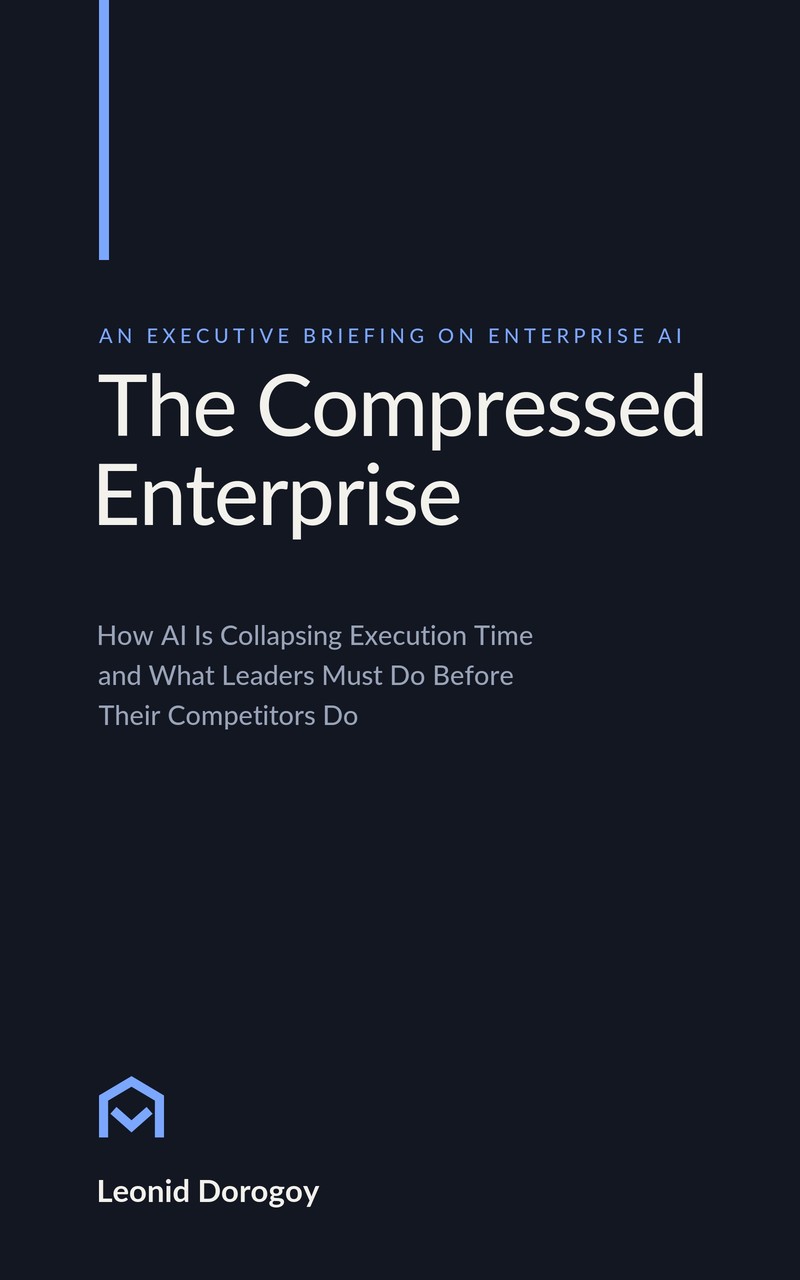
The Compressed Enterprise

How AI Is Collapsing Execution Time and What Leaders Must Do Before Their Competitors Do

Your planning cycle runs twelve to eighteen months. Frontier AI capability doubles every four to seven.

AmazonKindle · Paperback · HardcoverComing soon Apple BooksComing soon Google PlayComing soon

15,587 words  ·  106 pages  ·  10 diagrams  ·  First edition, 2026

Cover of The Compressed Enterprise by Leonid Dorogoy

The argument

That is the whole argument, and it is arithmetic rather than opinion. The assumptions behind your largest current technology programme have been superseded two to four times since you approved it. It will land on time, on budget, and priced for a world that stopped existing around its ninth month.

Between 2024 and 2026 three things collapsed at once: the unit price of machine reasoning, the skill floor required to produce a working artefact, and the coordination overhead between specifying work and receiving it. Work that needed an analyst, an engineer, three requirement cycles and a vendor statement of work is now done by a small internal team in a fraction of the time.

Most organisations have not noticed, because most executives experience AI as an advisor that suggests while they still do the work themselves.

Evidence first

This is not the book you have already skimmed.

It leads with the evidence against its own argument.

Roughly 95 per cent of enterprise generative AI pilots produce no measurable effect on profit. Gartner expects more than 40 per cent of agentic AI projects to be cancelled by the end of 2027. A controlled trial found experienced developers working 19 per cent slower with AI tools while believing they were 20 per cent faster.

Those findings are quoted with their methodology attached, not explained away. They are also the reason the book exists, because they describe a failure of adoption rather than a failure of capability, and the two need completely different treatments.

What you get

Frameworks you can use this quarter.

The four-layer Enterprise AI Stack.Context, Reasoning, Execution, Agency. Most large organisations have built two of them and stopped exactly where the value begins.
The advisor-to-executor diagnostic.One question you can apply to your own organisation inside an hour, and the four levers that move you across the line.
The Governance Grid.A two-by-two that replaces months of policy debate with a five-minute placement decision, built for regulated environments including ADGM, DIFC, CBUAE and the EU AI Act as it stands after the 2026 Omnibus.
The seven reasons pilots produce nothing, and the profile of the five per cent that work.Not one of the seven is a technology decision.
The first ninety days as a sequence rather than a strategy.One workflow, one owner, one measured baseline, one visible result.
Twelve questions for your next leadership meeting, and ten diagrams you can lift straight into a board pack.
Who it is for

For anyone accountable for staying competitive.

Chief executives, CIOs, CTOs, chief data officers, heads of digital and strategy, enterprise architects and board members. Anyone accountable for whether their organisation is still competitive in three years.

No code. No architecture diagrams. No predictions about 2030. Short enough to finish on a single flight, and every chapter ends with something you can act on this quarter.

Contents

Fourteen chapters in five parts.

What Actually Changed

  1. The Ground Moved While You Were Budgeting
  2. The Collapse of Execution Cost
  3. From Advisor to Executor

The Enterprise AI Stack

  1. Layer One: Context, the Asset You Already Own
  2. Layer Two: Reasoning, and Why a Licence Is Not a Capability
  3. Layer Three: Execution, Where the Value Actually Lands
  4. Layer Four: Agency, From Assistance to Delegated Work

Why It Isn't Working

  1. The Six Objections, Answered Honestly
  2. Why Most Pilots Produce Nothing
  3. Governance Without Paralysis

What to Do

  1. The First Ninety Days
  2. What This Looks Like in Your Industry
  3. What the Executive Does Differently

Closing

  1. We May Soon Run Out of Time

About the author

Leonid Dorogoy

Leonid Dorogoy is a technology executive specialising in enterprise AI, data platforms and digital transformation. Over the past fifteen years he has led engineering and AI initiatives across banking, fintech and regulated financial services in the UAE and Europe, helping organisations adopt modern data and AI capabilities at scale.

He writes about enterprise AI adoption and executive technology strategy on LinkedIn.

Get the book

The Compressed Enterprise.

Coming to Kindle, Apple Books and Google Play.

AmazonKindle · Paperback · HardcoverComing soon Apple BooksComing soon Google PlayComing soon

Links go live as each store approves. First edition, 2026.